
Free Things to Do in Zermatt
Village walks, Matterhorn photo spots, churches, old Walliser houses, riverside paths and low-cost ways to enjoy an expensive alpine resort for nothing.

Photo: Stephane Mingot / Unsplash
- ✓Zermatt is a pricey resort, but the view that defines it — the Matterhorn from the Kirchbrücke — costs nothing.
- ✓A self-guided village walk links the old Hinterdorf barns, the church, the river and the best free photo angles.
- ✓The mountaineers' cemetery and the parish church tell the Matterhorn's human story for free.
- ✓Sunset light on the peak — the alpenglow — is the cheapest spectacular in the village; just be on a bridge at the right hour.
The view that costs nothing
Zermatt has a reputation for relieving visitors of money, and the lifts and restaurants earn it. But the single most famous sight in the whole valley — the Matterhorn rising at the head of the village — is free, and you do not need to leave the streets to get a postcard of it. The classic angle is from the Kirchbrücke, the church bridge over the Vispa river, where the peak lines up above the rooftops. Stand there once in good light and you understand why people travel across the world for this village.
Because Zermatt is car-free, simply walking it is a pleasure rather than a chore. The whole place can be crossed on foot in twenty minutes, the air is quiet, and the best of it — the old quarter, the river, the bridges, the cemetery — asks nothing but your time. Treat the village itself as the attraction and a surprising amount of a Zermatt day costs nothing at all.

A free self-guided village walk
The best free half-day in Zermatt is a slow loop on foot. Start at the station end of the Bahnhofstrasse and follow it through the heart of the village, then duck into the Hinterdorf — the old quarter, where dark larch barns and granaries stand on stone discs (the Mausstei) that once stopped mice climbing into the stored grain. These weathered timber houses are the real, pre-resort Zermatt, and they are simply there to be admired from the lanes; be quiet and respectful, as people still live among them.
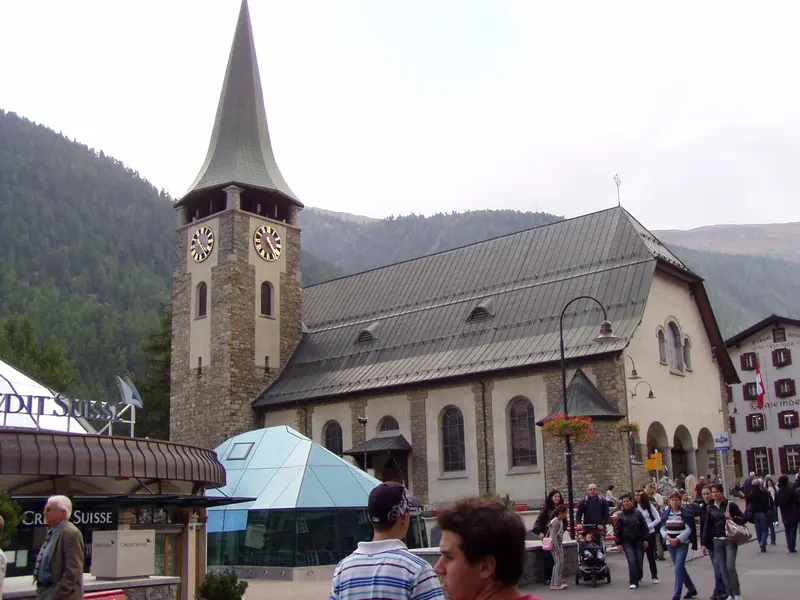
From there it is a short walk to the parish church of St. Mauritius and the river. Cross to the Kirchbrücke for the headline Matterhorn view, then follow the riverside path beside the Vispa, crossing and recrossing the bridges. The water runs grey-green with glacier silt, loud after a warm day. Loop back through the streets and you have seen the soul of the village without spending a franc.
If you want the route written out stop by stop, the dedicated village-walk guide links the same points — station, main street, old village, church, cemetery and river — into a single gentle line you can follow at your own pace.
- Bahnhofstrasse: the car-free main street — window-shop the watch and gear stores for free.
- Hinterdorf old quarter: weathered larch barns on mouse-stop stones; admire quietly from the lanes.
- Kirchbrücke (church bridge): the classic free Matterhorn-over-rooftops photo.
- Vispa riverside path: flat, shaded and full of bridges to cross.

Churches, the cemetery and the Matterhorn's story
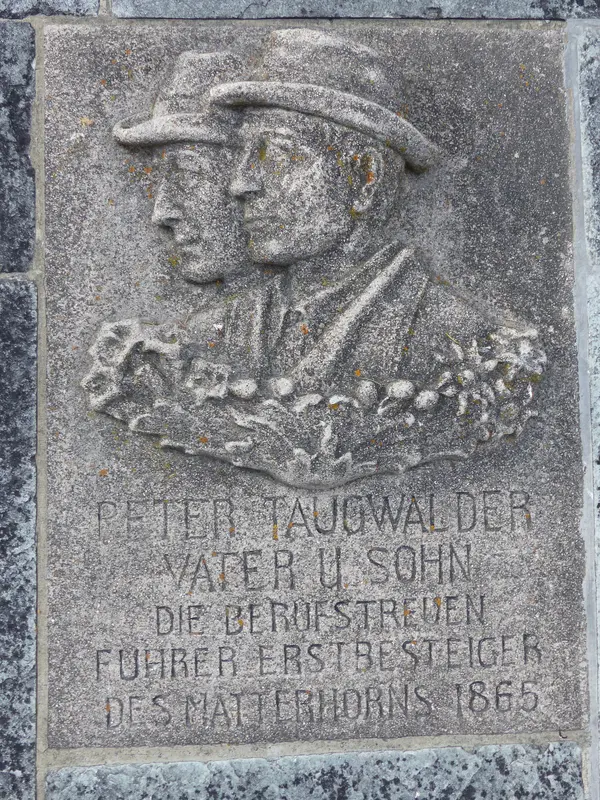
Some of Zermatt's most moving free stops are tied to the mountain's history. Beside the parish church lies the mountaineers' cemetery, where headstones remember climbers lost on the Matterhorn and the surrounding peaks — including victims of the 1865 first ascent, when four men died on the descent after the rope broke. It is a quiet, sobering place that gives the postcard peak its weight. Visit respectfully; it is a working cemetery, not an exhibit.
The parish church of St. Mauritius and the small English Church speak to the two cultures that built the village's mountaineering era: the local Walliser community and the British climbers who came in the golden age of alpinism. Stepping inside, where open, costs nothing and adds real context to everything you will later see from the lifts.
Pair these with the cemetery and the old village and you have a free 'history walk' that explains why Zermatt matters far beyond its views. For the full first-ascent drama there is a paid museum, but the streets alone tell much of the tale.
Free light, animals and easy nature
The cheapest spectacular in Zermatt is light. On a clear evening the Matterhorn catches alpenglow — the peak glows pink and gold as the sun drops — and at dawn it does the same in reverse. You do not need a lift ticket for either; you need to be on a bridge or an open street at the right moment. The riverbank and the Kirchbrücke both work, and the show changes minute by minute, which is half the pleasure.
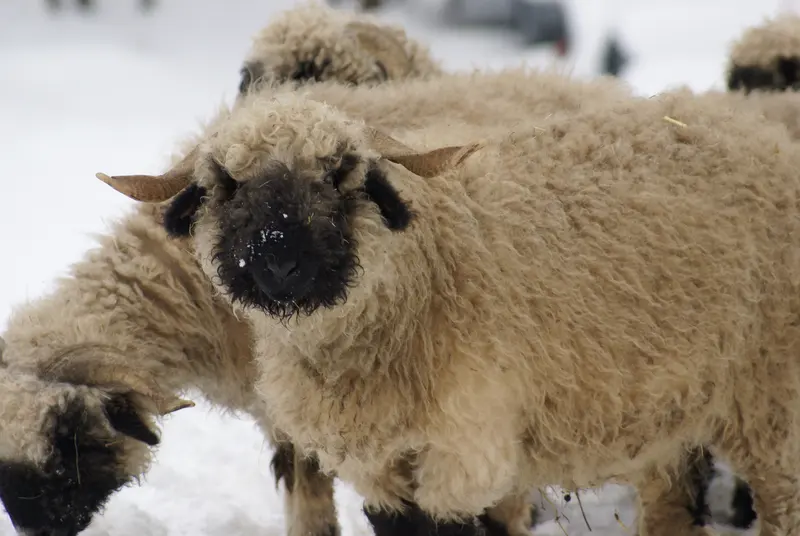
Animals are a free delight too. In the warmer months the famous Valais blacknose sheep, with their woolly faces and curled horns, graze on the slopes around the village, and Zermatt keeps a small herd of black-necked goats that are sometimes herded down the main street in summer — a genuine event that draws a crowd. Watch from a distance and never feed them.
For low-cost nature with a little effort, the flat valley paths toward Furi and along the river give you forest, glacier-fed water and Matterhorn glimpses without a single lift fare. Save the paid cable cars for a clear day and let the free valley fill the rest.
- Alpenglow at dawn or dusk on the Matterhorn — free, and best from a bridge or open street.
- Blacknose sheep on the slopes and black-necked goats in the village — watch from a distance, don't feed.
- Flat valley and riverside paths toward Furi for forest and glacier water without a lift fare.
- Window-shopping, people-watching and the buzz of the Bahnhofstrasse after dark.
 Matterhorn sunrise & sunsetWhen and where to catch the peak's alpenglow at first light and blue hour.
 Best photo spots in ZermattFree village angles plus the paid high viewpoints, mapped by light and effort.
 Blacknose sheep in ZermattWhere and when to see the woolly-faced sheep, with respectful viewing tips.
At a glance — free Zermatt
A quick low-cost planning card. Most of these cost nothing year-round, but church access and the summer goat parade vary — confirm current details on the official sites.
- Best free view: the Matterhorn from the Kirchbrücke (church bridge).
- Best free walk: the self-guided village loop — main street, Hinterdorf, church, river.
- Best free history: the mountaineers' cemetery and the parish church.
- Best free light show: alpenglow on the peak at dawn or dusk.
- Best free wildlife: blacknose sheep and the summer black-necked-goat parade.
- Best free nature: flat valley and riverside paths toward Furi — no lift needed.
- Always verify: church opening, goat-parade timing and any seasonal closures.
Free with a pass or a ticket you already have
Some of Zermatt's best free experiences are not free in absolute terms but come bundled with something you have likely already paid for, and overlooking them wastes money. If you are staying overnight, ask your hotel about the local guest card or any included perks: in many Swiss resorts an overnight stay brings small extras, and even where it does not, the village's own e-bus loops between the lift stations are a low-cost or included way to get around that saves both legs and taxi fares. If you have bought a ski pass or a multi-day mountain pass, the scenic rides themselves — riding up simply for the view rather than to ski or hike — are effectively 'free' add-ons you have already covered, so use them on clear evenings for sunset as well as in the working day.
The same logic applies to Switzerland's national rail products. Holders of a Swiss Travel Pass or similar get reductions on some of the mountain railways and cable cars into and around Zermatt, which can turn an otherwise expensive viewpoint into a modest top-up rather than a full fare. The point is to audit what your existing tickets already include before paying again: the guest card, the e-bus, the unused hours on a mountain pass and the rail-pass discounts together can quietly fund a day of 'extra' sightseeing that costs you nothing more.
- Ask your hotel about any guest card or included perks for overnight stays.
- The village e-bus loops are a cheap or included way to move between lift bases.
- A ski or mountain pass makes extra scenic rides — including sunset trips — effectively free.
- Swiss Travel Pass and similar can cut mountain-railway fares to a small top-up.


Free in winter, free in summer
Which free pleasures are on offer depends on the season, so it pays to match expectations to the calendar. In summer the free menu is at its richest: the green meadows and riverside paths are open and walkable without a lift, the wildflowers colour the slopes, the blacknose sheep graze the high pastures, the goat parade clatters up the main street on summer mornings, and the long light gives both dawn and dusk alpenglow. A summer day in Zermatt can be filled almost entirely for free, with paid lifts reserved for the one clear day you most want a high view.
Winter shifts the free offering toward the atmospheric rather than the active. The village is at its most beautiful under snow and lights, and a slow evening stroll through the hushed, car-free streets with the floodlit Matterhorn overhead costs nothing and rivals any paid attraction. Window-shopping the lit Bahnhofstrasse, watching the après crowd, admiring the church and its snow-laden cemetery, and simply soaking up the snow-globe quiet are all free. Prepared winter footpaths on the valley floor give a gentle, no-lift walk when conditions allow. The constant across both seasons is the same: the Matterhorn, the river, the old village and the car-free streets are free at any time of year, and they are the things most visitors remember longest.
- Summer: meadows, riverside paths, wildflowers, sheep, the goat parade and long alpenglow — a near-free day.
- Winter: the snowy, lit, car-free village and the floodlit peak make the best free evening of the trip.
- Window-shopping, people-watching and the church and cemetery cost nothing in any season.
- The Matterhorn, river and old village are free year-round — the things visitors remember most.


Zermatt on a Budget Itinerary
A lower-cost two-to-three-day plan beneath the Horu — free village walks and viewpoints, the churches and the Hinterdorf, lakes you can reach on foot, careful pass and lift choices, groceries and picnics, and the Täsch tradeoff for cheaper beds in a famously expensive resort.
Read guide
Self-Guided Zermatt Village Walk
A gentle, step-by-step loop on the valley floor linking the station, the Bahnhofstrasse, the old timber Hinterdorf, the church and cemetery, the river bridges and the best Matterhorn angles.
Read guide
Zermatt costs & budget
Realistic, honest cost planning for a Zermatt trip — hotels, trains, lift passes, mountain meals, ski rental, spas and the splurges — with the levers that let you spend less and the moments worth paying for.
Read guideMore in Things to Do
6
Bahnhofstrasse Zermatt Guide
The spine of the car-free village — the shops, restaurants, hotels and après-ski energy of Zermatt's main street, with practical orientation from the station to the Matterhorn.
Read guideBest Photo Spots in Zermatt
Matterhorn photo locations from the village bridges, Gornergrat, Riffelsee, Stellisee and Rothorn, with sunrise routes and reflection timing.
Read guide
Best Things to Do in Zermatt
A ranked, first-trip shortlist for a car-free resort under the Matterhorn — the ascents, walks, ski days and long mountain lunches worth building a trip around.
Read guide
Rainy Day Zermatt
Museums, spas, cafés, fondue, hotel lounges, scenic trains, short walks and lift-backup logic for making the most of bad weather in the mountains.
Read guide
Swiss National Day in Zermatt
How Zermatt marks Swiss National Day on 1 August — flags and bunting on the Bahnhofstrasse, music and food, the lakeside gathering at Leisee, family planning and the village's car-free festivity beneath the Matterhorn.
Read guide
Zermatt Folklore Festival
What the Zermatt Folklore Festival is and how to plan around it — traditional Valais costumes, alphorns and flag-throwing, the village atmosphere, August hotels and a hiking-and-folklore weekend beneath the Matterhorn.
Read guide