
Old Village Hinterdorf
Weathered larch barns, raised granaries on their flat stone discs, photo etiquette and how the Hinterdorf quarter reveals the farming village Zermatt was before the mountaineers came.

- ✓Hinterdorf is the oldest surviving quarter of Zermatt — a dense knot of timber barns, stables and stadel (granaries) some dating to the 16th–18th centuries.
- ✓The dark, almost black larch is sun-tanned, not painted: a century or three of high-altitude UV bakes the wood to that colour.
- ✓Look for the round flat stones — Mausplatten — set between the granary posts and the loft to stop mice climbing into the grain.
- ✓It sits a couple of minutes off the Bahnhofstrasse behind the parish church; free, open-air and best at first or last light.
The village before the village
Before the Matterhorn made Zermatt famous, Zermatt was a high farming hamlet of a few hundred souls who grew rye on impossibly steep terraces, ran cattle up to the alps in summer and survived the winters on what they had dried, smoked and stored. The Hinterdorf — literally the 'back village' — is the quarter where that older life is still legible. Walk two minutes off the bright Bahnhofstrasse, past the parish church, and the souvenir windows fall away. The lanes narrow, the light drops, and you are suddenly among tar-dark timber barns leaning companionably together, their lofts heavy with the memory of grain and hay.
It is the single most atmospheric corner of the village, and one of the few places in Zermatt where you can stand still and feel the centuries. Nothing here is staged: people still own these buildings, still store wood and tools in them, and a few are quietly lived in. That lived-in quality is exactly what makes it worth the detour — and what asks a little courtesy of the visitor.
Reading the buildings: stadel, speicher and the stone discs
Once your eye adjusts, the Hinterdorf becomes a textbook of Walliser timber architecture. The two building types to learn are the stadel (the raised granary, used to store rye, grain and dried meat) and the speicher or stable-barn for animals and hay. The giveaway detail — the thing every photographer eventually crouches to frame — is the row of round, flat stone discs set on top of short timber or stone legs, with the loft balanced on top of them.
Those discs are Mausplatten, 'mouse plates'. A mouse can climb the leg, but it cannot get past the overhanging rim of the stone, so the stored grain stayed safe. It is a piece of pre-industrial cleverness repeated all over the Valais and the Bernese highlands, and seeing dozens of them clustered in one place is part of what gives the Hinterdorf its strange, stilted beauty.
The colour does the rest. People often assume the wood is stained or tarred, but the deep brown-black is simply sun: at 1,600 m the ultraviolet is fierce, and over a hundred or two hundred years it bakes larch to that rich, almost charred tone while the protected undersides stay paler. Look at a south-facing gable next to a north-facing one and you can read the difference like the rings of a tree.
- Stadel — raised granary on stone-disc legs, for rye, grain and dried meat.
- Speicher / stable — for hay and animals, usually lower and broader.
- Mausplatten — the flat round 'mouse stones' that stop rodents reaching the loft.
- Sun-tanned larch — the black colour is UV and age, not paint or tar.
Photographing Hinterdorf — and the etiquette that comes with it
This is one of the great photo corners of Zermatt, and on a clear day the reward is unmistakable: frame a dark timber lane so that the Matterhorn floats at the end of it, and you have the picture that says 'old Zermatt' in a single frame. The low golden light of early morning and the last hour before sunset rake across the wood and make the grain glow; the harsh midday sun flattens everything, so time your visit if you can.
But the Hinterdorf is not a film set. These are private barns, a few of them homes, on lanes that locals use every day. Keep your voice down, don't block doorways or set up tripods across a working passage, and never open a barn or step inside — what looks abandoned is usually someone's store. If a resident is around, a nod and a quiet 'Grüezi' goes a long way. Treat it as you would a chapel you've wandered into: with curiosity, but lightly.
- Best light: the first hour after sunrise and the last hour before sunset.
- The signature shot: a dark timber lane with the Matterhorn framed at the far end.
- Stay on the lanes; don't enter, lean on, or block the barns — many are in private use.
- Keep noise down and give residents room; it is a living quarter, not an exhibit.
Life inside the dark timber
It is worth pausing to imagine the lives these buildings were built for, because that is what gives the Hinterdorf its weight beyond the photogenic surface. A Walliser farming family lived vertically with its food: people in the house, animals in the stable below or alongside, hay in the lofts, and the precious rye sealed up in the raised stadel where neither mice nor damp could reach it. Everything was sized to a brutal arithmetic of survival — how much grain, how much hay, how many cattle a family needed to carry through a winter that could bury the village for months.
The terraces of rye, now mostly gone, climbed the slopes above; the cattle went up to the high alps in summer and came down in autumn in the noisy, flower-decked procession that some Alpine villages still keep. Bread was baked communally and infrequently, then dried hard and stored. Meat was salted and air-dried into the Walliser specialities you can still order in the village restaurants. Standing among the barns, you are looking at the infrastructure of that economy: not quaint decoration, but the machinery of a self-sufficient mountain life that persisted, in its essentials, until tourism rewrote everything within living memory.
- Families lived stacked with their food: people, animals, hay and sealed grain under one cluster of roofs.
- Rye grew on steep terraces above the village; cattle summered on the high alps.
- Bread was baked rarely and dried; meat was air-dried into the Valais specialities still served today.
- The barns are working infrastructure of a subsistence economy, not ornamental heritage.
How it fits a walk through the village
Hinterdorf is small — you can see the heart of it in fifteen or twenty unhurried minutes — so it works best as one stop on a slow loop through Zermatt rather than a destination in itself. From the station, stroll the Bahnhofstrasse, slip behind the parish church of St. Mauritius into the old quarter, then drop down toward the Vispa river and follow the water back. That gentle circuit threads together the village's three faces: the busy shopping street, the medieval farming core, and the rushing glacier-fed river.
Because it is open-air and free, the Hinterdorf is also a perfect rainy-day-adjacent or budget stop — there is no ticket, no opening time to chase, and it photographs beautifully under low cloud, when the wet wood goes nearly black. Pair it with the underground Matterhorn Museum a stone's throw away to put the old houses into the wider story of the village and the mountain that changed it.
 Zermatt village guideThe Bahnhofstrasse, the old quarter, churches, bridges and Matterhorn angles, gathered into one walk.
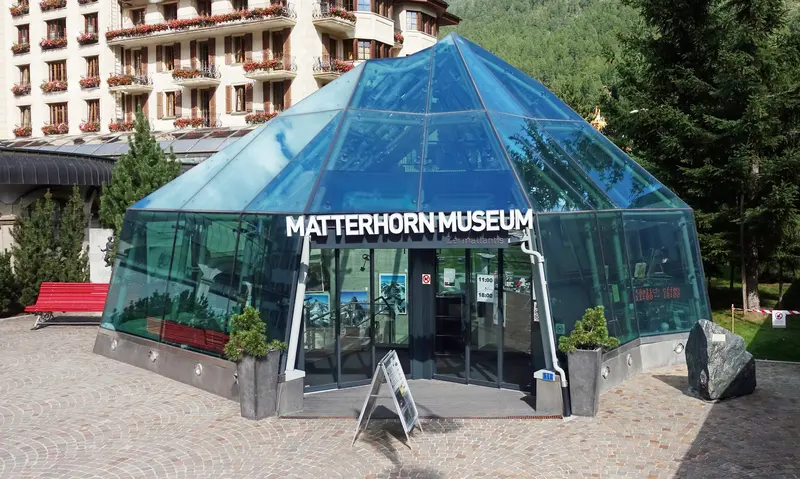 Matterhorn MuseumThe underground museum a minute away, where the old village's story meets the mountain's.
 Zermatt photography spotsWhere the dark-timber lanes, the river and the high viewpoints give the cleanest Matterhorn frames.
At a glance
A quick orientation before you go. As ever in Zermatt, treat opening details and any guided-tour times as things to verify locally — but the quarter itself is always there, free and open to the sky.
- What it is: Zermatt's oldest surviving quarter — timber barns, stables and raised granaries, some 16th–18th century.
- Where: a couple of minutes off the Bahnhofstrasse, behind the church of St. Mauritius, toward the Vispa river.
- Cost & hours: free, open-air, accessible any time; no ticket required.
- Best for: photography, slow village wandering, a budget or low-effort stop, atmosphere in any weather.
- Time needed: 15–30 minutes; longer with photo stops.
- Etiquette: stay on the lanes, don't enter the barns, keep quiet — it is a living, partly private quarter.
The Hinterdorf through the seasons
The old quarter changes character with the year, and it is worth knowing which mood you are likely to meet. In high summer the lanes are busiest, but the long evenings give you a generous window of warm, low light after the day-trippers thin out — arrive around dinner time and you can have the barns almost to yourself with the sun raking gold across the timber. Autumn is many photographers' quiet favourite: the air is sharp and clear, the larches on the slopes above turn, and the Matterhorn often stands cleaner against the sky than in the haze of midsummer.
Winter transforms it again. Snow caps the stone discs and lofts, lamplight catches the wet-dark wood, and the contrast between the white roofs and the near-black timber is at its most dramatic. The lanes can be icy, so wear proper footing, but a dusting of fresh snow over the Hinterdorf is one of the most beautiful and least crowded sights in the whole village. Whatever the season, the quarter is at its best at the edges of the day, when the crowds are gone and the light is kind — plan around those hours and you will see the old village as it deserves to be seen.
- Summer: busiest by day, but long golden evenings give the lanes back to you after dinner.
- Autumn: clear sharp light, turning larches and a cleaner Matterhorn — a photographer's favourite.
- Winter: snow on the stone discs and lofts, dramatic dark-and-white contrast, but watch for ice.
- Any season: go at first or last light, when the crowds have gone and the wood glows.
Zermatt Village Guide
How the car-free village fits together on the floor of the valley — the Bahnhofstrasse spine, the old timber Hinterdorf, the church and cemetery, the river, the museum and the angles on the Horu.
Read guideBest Photo Spots in Zermatt
Matterhorn photo locations from the village bridges, Gornergrat, Riffelsee, Stellisee and Rothorn, with sunrise routes and reflection timing.
Read guideMatterhorn Museum (Zermatlantis)
Zermatt's museum is buried beneath the Kirchplatz: a reconstructed old village under glass, the drama of the 1865 first ascent, and one of the best rainy-day depths in the village.
Read guide