
Zermatt's Black-Necked Goats
The black-and-white Valais goats that walk the Bahnhofstrasse on summer mornings — when the parade runs, where to stand, and how to watch it kindly.
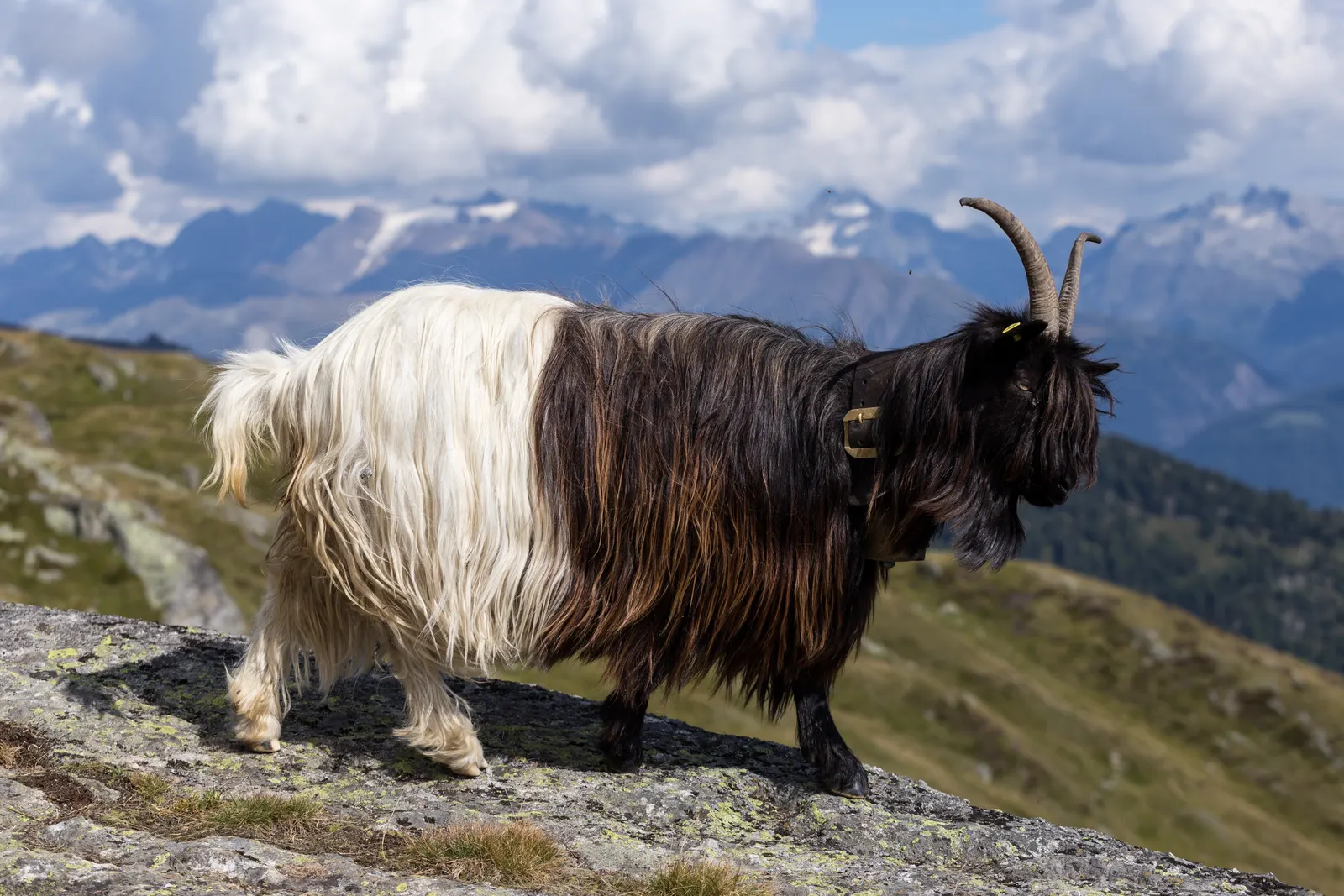
Photo: JoachimKohler-HB / Wikimedia Commons · CC BY-SA 4.0
- ✓Zermatt's goats are Valais Blackneck (Walliser Schwarzhalsziege) — sharply split black-front, white-rear, with long shaggy coats and curved horns.
- ✓On summer mornings a herd is walked up the village to pasture and back down in the late afternoon — the much-loved 'Geissenkehr'.
- ✓The classic spot is the lower Bahnhofstrasse near the church, where the herd passes through the car-free street.
- ✓It runs in the summer grazing season only and timings can shift — verify locally before you set an alarm for it.
A village tradition on four legs
There are few sights in the Alps as quietly joyful as Zermatt's goats clattering up the main street while the village is still rubbing its eyes. These are Valais Blackneck goats — Walliser Schwarzhalsziegen — one of the oldest and most striking breeds in Switzerland: long-haired, curve-horned, and painted as if by a designer, jet black across the front half of the body and pure white across the back, with a hard line between the two. They are native to this canton, and in Zermatt they are part of living folklore rather than a staged show.
On summer days the herd is taken up from the village to graze the higher meadows in the morning and brought back down in the afternoon — a daily round known affectionately as the Geissenkehr, the 'goats' turn'. For a few minutes the car-free Bahnhofstrasse fills with bells, bleating and the patter of hooves on stone, the goats threading between hotels and shop windows under the eye of a goatherd. It is unhurried, faintly comic and entirely real, and it has become one of the village's best-loved free spectacles.
When and where to catch them
The goat walk is a creature of summer. It runs during the warm grazing months, when there is open pasture above the village to graze; outside that season the goats are not paraded through the streets. Within the season there is a morning departure up to the meadows and an afternoon return, so you generally get two chances a day. Exact timings and the precise season vary year to year and are not something to trust from memory — ask at the tourist office, your hotel reception or a notice board, and confirm before you build a morning around it.
For position, the lower Bahnhofstrasse around the parish church is the classic vantage: the herd moves through the pedestrian heart of the village, so you simply need to be on the route a few minutes early. Arrive ahead of the announced time, find a doorway or a wall to stand against so the goats have room to flow past, and let them come to you. The whole thing is over in minutes, so resist the temptation to chase the herd up the street — pick your spot and let the parade do the work.
- Season: summer grazing months only; not run in winter.
- Two passes most days — up to the pasture in the morning, back down in the afternoon.
- Best spot: the lower Bahnhofstrasse near the church, on the herd's route.
- Verify the current season and times locally (tourist office / hotel) — they change.
Watching with good manners
The goats are tame and used to crowds, but they are working animals being moved through a public street, and the kindest viewing is the calm kind. Give them room to pass, keep small children close at hand height rather than under hooves, and don't crowd the herd or block its line — the goatherd needs the animals to keep moving. Please don't feed them: it disrupts the walk, isn't good for them, and teaches them to mob visitors. A few quiet seconds of letting them stream past you, bells ringing, is worth more than any selfie wrestled out of a startled goat.
For photographs, the bells and the morning light do half the work. Crouch to the goats' level, frame the split black-and-white coats against the stone street or a shop window, and shoot bursts as they move — they rarely hold still. If you have a dog with you, keep well back and leashed; a herd on the move and an excited dog are a poor mix on a narrow street.
- Give the herd space and let it keep moving — don't block or chase it.
- Don't feed the goats; it disrupts the walk and isn't good for them.
- Keep dogs leashed and back from the herd.
- Shoot low and in bursts for photos — the split coats and bells make the picture.
A perfect early start for families
The goat parade is an ideal opener for a family day in Zermatt: it is free, it is short, it happens right in the village so there is no logistics to manage, and it gets everyone up and out before the cog railway gets busy. Watch the morning walk, fold straight into breakfast at a bakery on the same street, and you have already given the children a story before the 'serious' sightseeing begins. The afternoon return makes a gentle bookend to a day on the mountain.
If the timing or the season doesn't line up, the village keeps the theme alive: the black-and-white goats appear on souvenirs and shop signs, and you can chase real livestock instead on the high summer pastures, where the valley's flocks and herds graze for the season. The goats are simply the most accessible of them — the wildlife that comes to you, down the main street, with bells on.
The breed, and why it matters here
The Valais Blackneck is not just a photogenic animal; it is one of the signature livestock breeds of this canton and a genuine piece of its heritage. The breed is old — herds of these sharply two-toned goats have grazed the Valais valleys for centuries — and it is adapted to exactly the kind of country that surrounds Zermatt: steep, stony pasture, big altitude swings, and a short, intense summer between long winters. The long, shaggy coat that makes them look so theatrical is functional, insulating them against cold nights on the high meadows, and the curved horns carried by both sexes help them hold their own on rough ground.
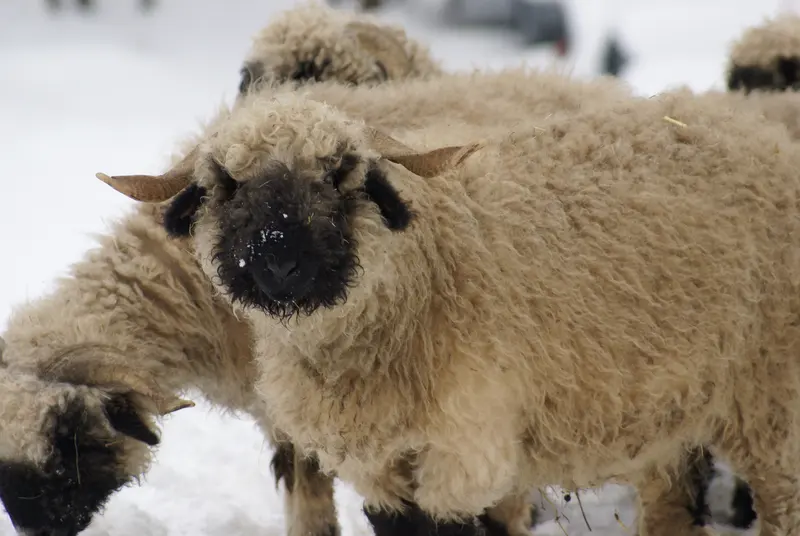
Like Zermatt's better-known Blacknose sheep, the goats are part of a wider Valais tradition of striking, hardy mountain breeds kept as much for identity and the alpine economy as for milk or meat. Numbers of these old breeds dipped over the twentieth century as farming changed, and they are now valued and deliberately kept going — which is part of why a goatherd still walks a herd up the main street of a world-famous resort each summer morning rather than quietly trucking them to pasture. The parade is tourism, yes, but it is also a living thread of agricultural culture that the village has chosen not to drop.
Understanding that turns the spectacle from a cute photo op into something with more weight behind it. These are not props; they are a working flock of a regional breed, doing more or less what such flocks have done here for generations, on a street that happens now to be lined with watch shops and grand hotels. The contrast is the charm.
- Valais Blackneck (Walliser Schwarzhalsziege) — a centuries-old canton breed.
- Long coat and curved horns suit steep, cold, high pasture.
- Part of the same Valais heritage as the famous Blacknose sheep.
- Old breeds like these are now deliberately conserved, not just paraded.
Beyond the parade: goats in the wider trip
If you miss the street walk, or want more than a five-minute glimpse, the goats and their breed thread through the rest of a Zermatt visit in ways worth knowing. The summer pastures above the village — the same high meadows the herd is walked up to — are where you may meet grazing livestock at close quarters on a hike, bells sounding across the slope long before you see the animals. Routes through the Sunnegga and Findeln side, or the gentle ground around Furi, give the best chance of crossing paths with grazing flocks and herds in the warm months, and the encounters there feel earned rather than staged.
Back in the village, the black-and-white motif is everywhere once you start looking: carved on signs, printed on souvenirs, worked into shop displays and the occasional fountain or mural. For children, turning the day into a hunt for goat imagery — real first, then drawn and carved — is an easy game that costs nothing and keeps tired legs moving between bigger attractions. And because the morning walk is free and central, it slots painlessly into almost any itinerary as a low-commitment opener that asks nothing more than getting out of bed a little earlier than you might have liked.
- Summer hikes on the high pastures are the place to meet grazing livestock for real.
- The Findeln, Sunnegga and Furi areas give the best odds of close encounters.
- The goat motif recurs on village signs and souvenirs — an easy game for children.
- Free and central, the parade folds into almost any morning with minimal effort.

Bahnhofstrasse Zermatt Guide
The spine of the car-free village — the shops, restaurants, hotels and après-ski energy of Zermatt's main street, with practical orientation from the station to the Matterhorn.
Read guide
Geissenkehr Goat Parade
Twice a day in summer, Zermatt's black-necked goats are driven down the Bahnhofstrasse to and from their high pasture — a small, free, genuinely local ritual worth catching.
Read guide
Zermatt With Kids
Family-friendly lifts, Wolli Park, Leisee, easy walks, the Matterhorn Museum, sledging and low-stress mountain days in a car-free village built for small legs.
Read guide