
Gorner Gorge (Gornerschlucht)
A short walk from the village, wooden walkways thread a deep slot of polished glacier-carved rock above the rushing Gornervispa — an easy, atmospheric, seasonal outing that pairs neatly with Furi.
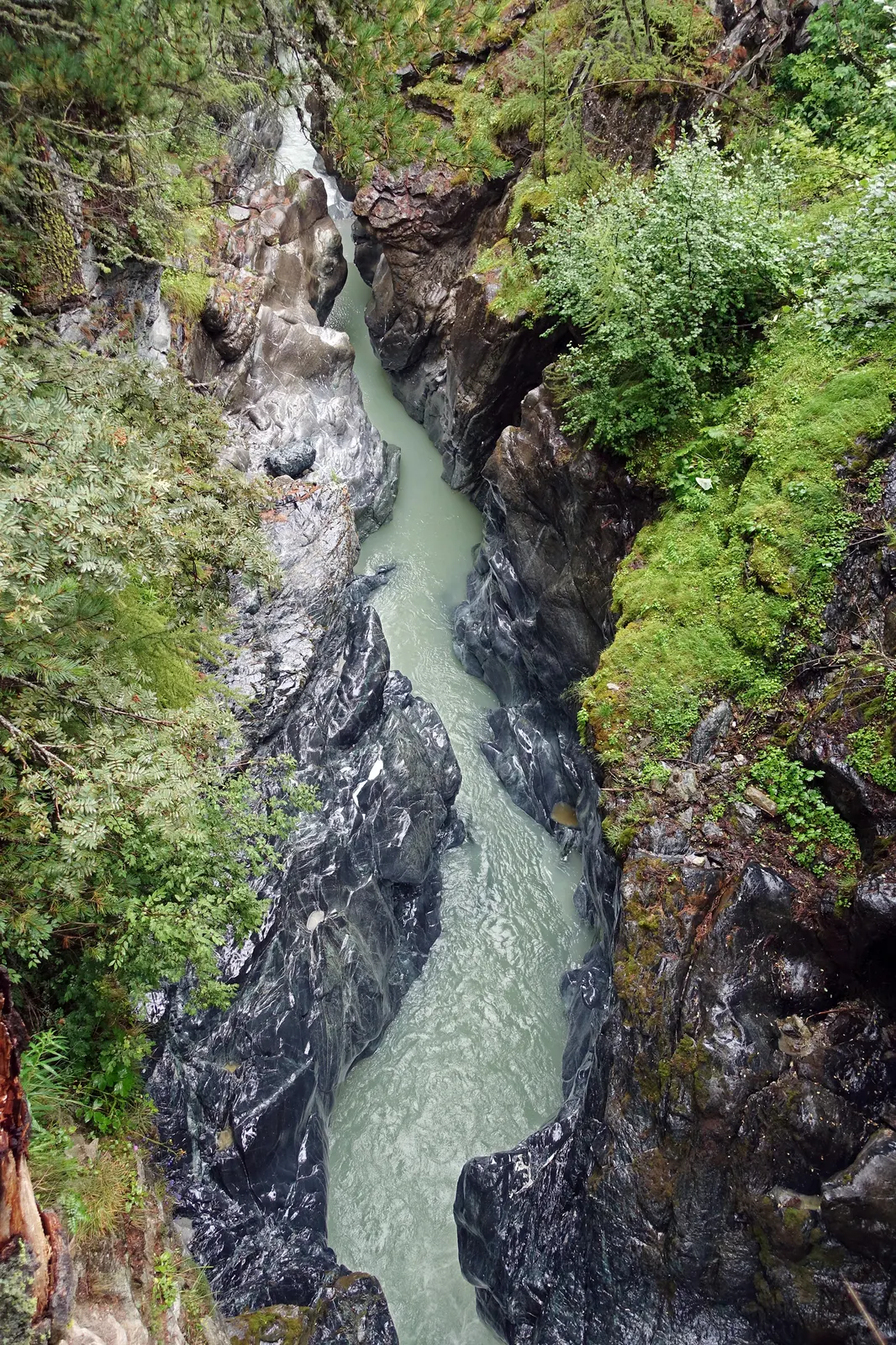
Photo: Tiia Monto / Wikimedia Commons · CC BY-SA 3.0
- ✓The Gornerschlucht is a narrow gorge cut by the Gornervispa — the glacier meltwater from the Gorner glacier — into smooth, dark serpentine rock.
- ✓Bolted wooden walkways and bridges carry you right above the water through the deepest, narrowest part of the slot.
- ✓It is a short, easy, mostly flat outing reachable on foot from the village in roughly 20–30 minutes via the Gorner / Furi direction.
- ✓It opens only in the warmer months (broadly late spring to autumn) and charges a small entrance fee — verify both before you go.
Where the glacier water goes
Everything in Zermatt eventually leads back to ice, and the Gorner Gorge is where you meet the runoff at full roar. The Gornervispa — meltwater draining from the great Gorner glacier high above the village — has spent millennia sawing down through a band of dark, glassy serpentine rock, polishing the walls to a near-marble sheen and carving a slot so narrow in places that the sky becomes a ribbon overhead. Bolted to those walls is a sequence of wooden walkways and footbridges that take you straight into the heart of it, a metre or two above water the colour of milky turquoise.
The effect is completely different from the airy, sunlit world of the high viewpoints. Down here it is cool, shaded and loud, the spray drifting up and the rock streaked green and grey. It is one of the village's most atmospheric short outings, and a clever way to feel the sheer power of the glaciers you admire from a safe distance up the mountain.
A short history of a long-known gorge
The Gornerschlucht is not a modern invention dressed up for tourists; it is one of the oldest accessible natural attractions in the valley. Walkways were threaded through it generations ago, in the early decades of Zermatt's life as a destination, so that the Victorian visitors who came for the Matterhorn could also peer into the underworld where its glaciers drained. Walking it today, you are following in the footsteps of those first curious travellers — and standing in a gorge the Gornervispa has been deepening, grain by grain, since long before any of them arrived.
That continuity is part of the charm. The wooden walkways are renewed as they weather, but the experience is essentially unchanged: a narrow timber path bolted to polished rock, the water loud below, the slot of sky narrowing overhead. Where a high-altitude excursion can feel like a feat of modern engineering, the gorge feels older and simpler — a place humans have always come to feel small beside moving water. It rewards the same slow, attentive mood as the village's old quarter and its quiet chapels: less a spectacle to be consumed than an atmosphere to be absorbed.
Getting there and what the walk is like
The gorge sits just outside the village on the way toward Furi, and the nicest approach is on foot: a walk of roughly twenty to thirty minutes from the centre, climbing gently out of Zermatt along the well-marked path. There is no lift needed to reach the gorge itself, which is part of its appeal — it is a low-effort, low-cost adventure compared with the cable-car days, and you can fold it into a half-day on the valley floor.
The gorge walk proper is short and largely flat once you are inside, following the walkways through the slot and back. The footing is wooden boards, often damp from spray, so wear shoes with grip and watch children near the edges. There is an entrance gate where you pay a modest fee, and the route is one-way-and-return through the narrowest section — reckon on well under an hour for the gorge itself, more with the walk to and from the village and any photo stops.
- On foot from the village toward Furi/Gorner: roughly 20–30 minutes, gently uphill.
- Inside the gorge: short, mostly flat wooden walkways and bridges; damp boards, so wear grippy shoes.
- An entrance fee applies at the gate; the gorge is seasonal and closed in winter.
- Allow under an hour for the gorge, more for the round-trip walk and photos.
Family fit and safety
The Gorner Gorge is a genuine hit with children — it is dramatic, loud, full of bridges and quite unlike anything else on a Zermatt trip — and the walkway sections are short enough not to wear out small legs. For families it makes an excellent low-key outing on a hot afternoon or a day when you want a break from lifts and altitude, and it slots easily alongside other valley-floor walks.
That said, this is a wet, exposed gorge with fast-moving glacier water below. The boards can be slippery, the drops are real, and there are gaps and railings rather than solid walls. Keep young children firmly in hand, don't let anyone climb on the railings, and skip it altogether if water levels look high after heavy rain or strong melt — the official gate may close it anyway in those conditions. Treat it as a thrilling but real piece of mountain terrain, not a theme-park ride.
 Zermatt with kidsFamily-friendly lifts, easy walks, lakes and low-stress mountain days, with the gorge among them.
 Easy walks in ZermattGentle, mostly flat valley-floor and lower-trail routes the gorge approach belongs to.
 Furi suspension bridgePair the gorge with the airy Furi crossing for a half-day on the village side of the valley.
The geology under your feet
Part of what makes the Gornerschlucht so striking is the rock itself. The walls are serpentinite — a dark, greenish, soapy-smooth stone formed deep in the earth and pushed up when the Alps were built. It is exactly the kind of rock that water polishes beautifully, and millennia of grit-laden glacier melt have worked the gorge walls to a sheen, scooping smooth hollows and flutes where the current presses hardest. In places you can see the strata folded and tilted, a reminder that this whole valley is the wreckage of a continental collision.
The water doing the carving is not ordinary river water. It is glacier milk: meltwater carrying a fine suspension of rock flour ground from the bedrock by the Gorner glacier far above. That suspended dust is what gives alpine melt its opaque, milky turquoise colour, and what makes it such a relentless abrasive. Standing on the boardwalk, you are watching a glacier dismantle a mountain in slow motion — the same ice you can ride up to admire from the Gornergrat, met here at the bottom of its long journey to the sea.
- The walls are serpentinite — dark, greenish, water-polished Alpine rock.
- The turquoise colour is 'glacier milk': meltwater carrying fine rock flour.
- The same Gorner glacier you see from Gornergrat is the source of the water below.
- Folded, tilted strata in the walls record the building of the Alps.

Pairing it with Furi or the village
Because the gorge lies on the Furi side, the obvious move is to make a half-day of it. Walk up to the gorge, continue or take the cable car on toward Furi for its suspension bridge, mountain restaurants and the trails fanning out toward Zmutt and Zum See, then loop back down to the village. It links the cool, enclosed drama of the gorge with the open, sunlit terraces above — a satisfying contrast in a single outing.
Equally, if you only have a free morning or a hot afternoon to fill, the gorge stands perfectly well on its own as an easy, cheap, memorable escape from the Bahnhofstrasse bustle. Either way, check that it is open and that conditions are safe before you set out, and bring a layer — it is noticeably cooler down in the slot than up in the sun.
A romantic detour, and a calmer alternative to the crowds
For couples, the gorge offers something the busy viewpoints rarely do: cool shade, comparative quiet and a sense of being somewhere secret. On a hot afternoon, when the Bahnhofstrasse is heaving and the lift queues are long, slipping down into the green half-light of the Gornerschlucht feels like stepping out of the resort and into the older, wilder valley. The roar of the water makes conversation intimate; the walkways are narrow enough that you go single file, hand on the rail, leaning to look. It is an unflashy, low-cost outing that nonetheless leaves a strong impression — exactly the kind of small adventure that a slow Zermatt trip is made of.
It also rewards timing. Early in the day, before the coach-trip and family rush, you may have stretches of boardwalk almost to yourself, with the spray catching the first sun that reaches down into the slot. Toward closing, as the light goes flat, the crowds thin again. Avoid the middle of a hot afternoon if you want the gorge at its most atmospheric, and remember that after heavy melt or rain the water can be ferocious — thrilling to watch, but a signal to check that the gate is open and conditions are safe before you commit.
- Cool, shaded and quiet — a welcome contrast to the sunlit, crowded high viewpoints.
- Narrow walkways make it intimate; the water's roar gives it drama.
- Go early or late for the fewest people and the best light reaching into the slot.
- After heavy rain or strong melt the water is dramatic — check the gate is open and safe.
Frequently asked questions
The practical questions that come up most, with the usual Zermatt caveat: opening dates, hours and the entrance fee change year to year, so confirm the current details before you build a day around the gorge.
- Is it open all year? No — the gorge is seasonal, broadly late spring to autumn, and closed through winter. Verify the current opening dates.
- Is there an entrance fee? Yes, a modest fee is charged at the gate; check the current price locally.
- How do I get there? On foot from the village toward Furi/Gorner, about 20–30 minutes; no lift is required for the gorge itself.
- Is it suitable for children? Yes, and kids tend to love it — but it is wet and exposed above fast water, so hold young children's hands and supervise closely.
- How long does it take? Under an hour for the gorge walk; allow extra for the round-trip from the village and photos.
- What should I wear? Shoes with grip for damp wooden boards, and a light layer — the gorge stays cool and shaded even on warm days.
Furi Suspension Bridge Guide
How to walk to the Furi suspension bridge above Zermatt — the short forest route, the Gorner Gorge add-on, the easy lift cheat, and where to stop for lunch in the Furi hamlet.
Read guideEasy Walks in Zermatt
Gentle, low-effort walks in and above Zermatt — the village and riverside, the Furi forest, Riffelalp's level paths and the Sunnegga-area strolls — for non-hikers, families and mixed-ability groups.
Read guideZermatt With Kids
Family-friendly lifts, Wolli Park, Leisee, easy walks, the Matterhorn Museum, sledging and low-stress mountain days in a car-free village built for small legs.
Read guide